How to Choose the Best Pasta Strainer for Small Kitchens
A small kitchen presents a familiar problem. Every tool you own must earn its space. If it sits unused in a drawer for months, it probably does not belong there. A pasta strainer, however, is one of the few tools you will reach for again and again. The challenge is finding one that performs brilliantly without taking up precious room.
The good news is that the market for compact kitchen tools has grown enormously in recent years. Designers now take small-space living seriously. As a result, there are more smart, well-made strainer options than ever before. Whether you live in a studio apartment, a shared house, or simply prefer a clutter-free kitchen, this guide will help you choose the right one.
Why Your Pasta Strainer Choice Matters More Than You Think
It is easy to underestimate a strainer. Many people grab the cheapest option without giving it much thought. However, a poor strainer causes real frustration. It warps under boiling water, lets pasta slip through oversized holes, or takes up so much cabinet space that storing it becomes a puzzle.
A good strainer, on the other hand, makes cooking easier every single time you use it. It drains water quickly and evenly, handles heat without warping, and stores away neatly when the meal is done. Therefore, spending a little time on this decision pays off in daily convenience.
The Different Types of Pasta Strainers
Before choosing a strainer, it helps to understand what is available. Each type suits different kitchens and cooking styles.
Traditional Colander
The classic colander is a bowl-shaped tool with holes throughout. It sits in the sink while you pour boiling pasta and water directly into it. Traditional colanders come in a wide range of sizes. Unfortunately, the standard sizes tend to be bulky. For a small kitchen, a colander with a diameter under 24 centimetres is worth seeking out. Some models also stack flat or nest inside pots, which saves a significant amount of storage space.
Over-the-Sink Strainer
An over-the-sink strainer extends across the width of your sink. It has two arms that rest on the sink rim, creating a draining platform above the basin. This design is a genuinely smart solution for tight kitchens because it does not require cabinet storage at all. You use it, rinse it, and hang it on a hook or slide it between your stove and counter. Additionally, it doubles as a washing surface for fruits and vegetables.
Clip-On Pot Strainer
A clip-on strainer attaches directly to the rim of your pot. You hold the lid firmly against the strainer and tilt the pot to let water pour out while the pasta stays inside. This is arguably the most space-saving strainer option on the market. It collapses flat and stores in a drawer. However, it requires a steady hand, and it works best with pots that have matching lids.
Fine Mesh Strainer
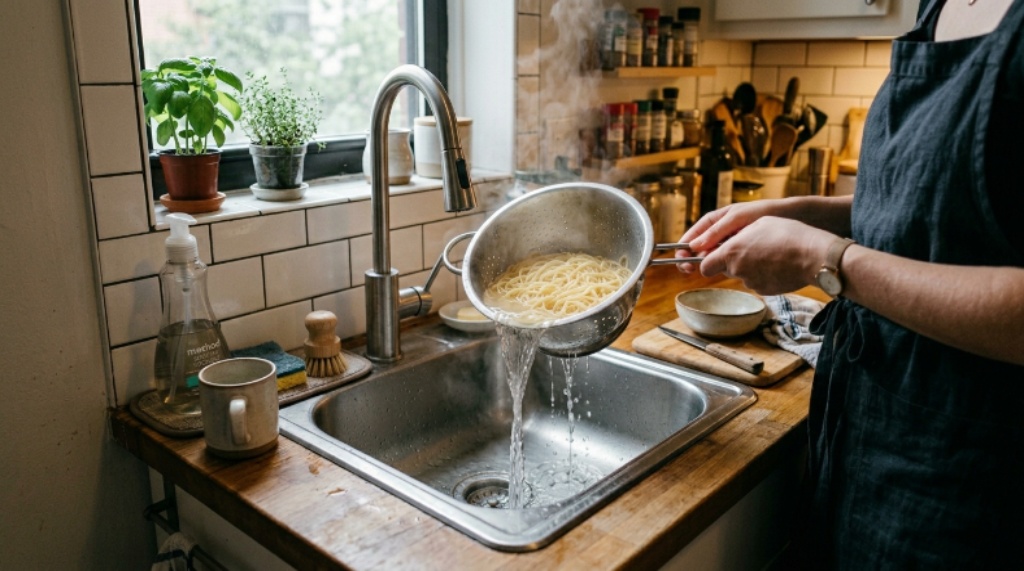
A fine mesh strainer is a multi-purpose kitchen tool. It drains pasta, rinses grains, strains sauces, and sifts flour. For a small kitchen where every tool must do more than one job, a fine mesh strainer earns its place easily. It comes in multiple sizes, and the smaller versions store compactly in a utensil holder or drawer. The trade-off is that very fine mesh can slow drainage slightly if the pasta is starchy.
Collapsible Silicone Strainer
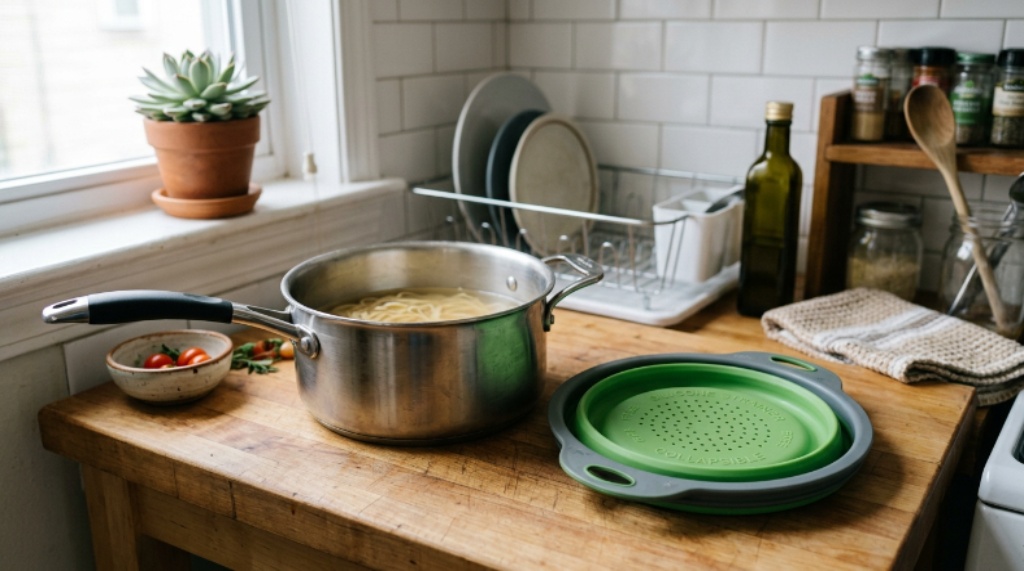
Collapsible silicone strainers are designed specifically for small spaces. They expand when in use and fold down to a fraction of their full size when done. Most collapse to about three to four centimetres in height, making them easy to tuck into a drawer. They are heat-resistant, lightweight, and easy to clean. However, the silicone frame can flex under the weight of a full pot of pasta, so always pour slowly and steadily when using one.
Key Features to Look for When Buying
Once you know which type suits your kitchen, there are several specific features worth evaluating before making a final decision.
Material and Heat Resistance
Stainless steel is the gold standard for durability and heat resistance. It does not warp, rust, or absorb odours. A stainless steel strainer will last for many years even with daily use. Silicone is a close second for heat resistance and offers the added benefit of being foldable. Plastic strainers are the least durable option and can warp or discolour over time. For a tool you plan to use regularly, stainless steel or silicone is the better investment.
Hole Size and Drainage Speed
The size of the holes determines how effectively water drains and how much pasta is retained. For standard pasta shapes like spaghetti, penne, or fusilli, medium-sized holes work well. However, for smaller pasta shapes like orzo or ditalini, you need a finer mesh or smaller perforations. A strainer with holes that are too large will let small pasta slip through into the sink, which is wasteful and frustrating.
Stability and Safety
Stability matters when you are handling a heavy pot of boiling water. Look for a strainer with a wide, stable base or secure attachment mechanism. Colanders with rubber feet grip the sink surface and prevent sliding. Clip-on strainers should have strong, heat-resistant clips that grip the pot rim securely. Additionally, handles or grips made from silicone stay cool to the touch, which is an important safety feature.
Ease of Cleaning
All strainers collect food debris in their holes or mesh. Some are far easier to clean than others. Wide-perforated colanders rinse out quickly under running water. Fine mesh strainers may need a soft brush to dislodge starchy residue. Check whether the strainer is dishwasher-safe before buying, especially if you rely on a dishwasher regularly. A strainer that is difficult to clean will quickly become a kitchen inconvenience rather than a help.
Storage Footprint
For a small kitchen, storage footprint is one of the most important buying criteria. Measure the space where you plan to store the strainer before purchasing. Collapsible and clip-on models offer the smallest footprint. Over-the-sink models eliminate storage concerns entirely. Traditional colanders can still work well if they nest inside your largest pot or stack with your other cookware.
Matching the Strainer to Your Cooking Habits
The best strainer for your kitchen depends not only on space but also on how you cook.
If you cook pasta several times a week, invest in a durable stainless steel colander that handles heavy use with ease. If you cook for one or two people, a smaller colander or a clip-on model is probably sufficient. If you enjoy variety in the kitchen and need tools that serve multiple purposes, a fine mesh strainer is one of the most versatile compact kitchen tools you can own.
Think also about whether you entertain guests regularly. Cooking a large batch of pasta for four or more people calls for a larger capacity, even in a small kitchen. In that case, an over-the-sink model that can handle volume without needing cabinet space is a practical solution.
Budget Guidance: What to Expect at Each Price Point
You do not need to spend a lot to get a quality strainer, but price does reflect material and build quality in most cases.
Entry-level strainers priced under fifteen dollars are usually plastic or thin stainless steel. They are fine for occasional use but may not hold up to daily cooking over several years. Mid-range options between fifteen and thirty-five dollars cover most well-made stainless steel colanders, silicone collapsible models, and clip-on designs. These represent the best value for most home cooks. Premium strainers above thirty-five dollars typically offer heavier gauge steel, refined ergonomics, and brand warranties. For passionate home cooks who use their tools daily, the upgrade is worthwhile.
Conclusion
Choosing the best pasta strainer for a small kitchen comes down to four things: type, material, functionality, and storage footprint. Decide which strainer style suits how you cook and how much space you have. Prioritize stainless steel or silicone for durability and heat resistance. Look for stable, safe designs that drain efficiently and clean easily.
From collapsible silicone models to over-the-sink designs, there are excellent space-saving strainer options for every budget and cooking style. The right choice will simplify your cooking routine and fit seamlessly into even the most compact kitchen. Do not settle for a tool that causes problems. With the right knowledge, you can find one that makes every pasta night easier.
Frequently Asked Questions
What is the best type of pasta strainer for a very small kitchen?
A collapsible silicone strainer or a clip-on pot strainer is ideal for very small kitchens. Both fold or collapse to minimal size for easy drawer storage. An over-the-sink strainer is another excellent option because it requires no cabinet space at all.
Are collapsible silicone strainers safe for boiling water?
Yes, most collapsible silicone strainers are rated for temperatures up to 200 degrees Celsius or higher, making them fully safe for draining boiling pasta. Always check the manufacturer’s temperature rating before use, particularly if you also plan to use it in the oven or microwave.
Can I use a fine mesh strainer for pasta?
Yes, a fine mesh strainer works well for pasta, especially smaller shapes like orzo or ditalini that slip through larger perforations. It also handles many other kitchen tasks, making it one of the most versatile tools for a small kitchen. The only downside is slightly slower drainage compared to a perforated colander.
How do I prevent my strainer from sliding in the sink?
Choose a colander with rubber feet that grip the sink basin. Alternatively, an over-the-sink strainer sits stably across the sink rim without any risk of sliding. For clip-on models, ensure the clips fit your pot rim snugly before pouring.
How do I clean a fine mesh strainer properly?
Rinse it immediately after use before starch dries in the mesh. Use a soft-bristled brush or an old toothbrush to dislodge any stuck food particles. Most fine mesh strainers are dishwasher-safe, but hand washing preserves the mesh better over the long term.